
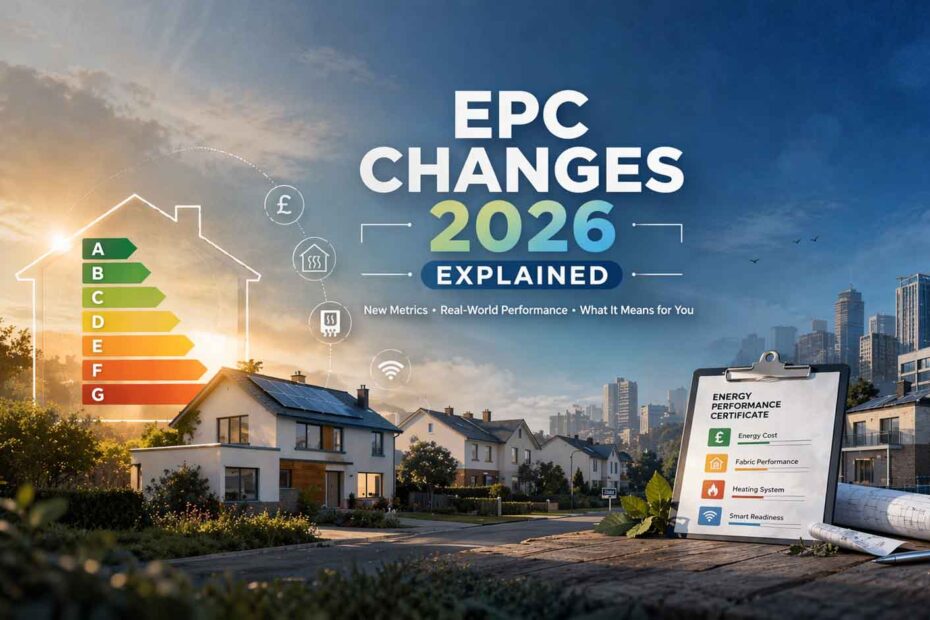
EPC Changes 2026 Explained: New Metrics Every Homeowner Must Understand
Major reform is coming to how EPCs are calculated, shifting away from a single rating
Introduction
If you own a property in the UK—whether as a homeowner or a landlord—there is a significant shift on the horizon that you cannot afford to ignore. The way Energy Performance Certificates (EPCs) are calculated and presented is changing, and the implications are far-reaching.
For years, EPCs have revolved around a single headline rating: a band from A (most efficient) to G (least efficient). Simple, yes—but also increasingly criticised for being overly simplistic, sometimes misleading, and not always reflective of how a property performs in the real world.
From 2026, that is set to change.
The UK government is moving towards a more nuanced, multi-metric system designed to give a clearer, more practical understanding of a property’s energy performance. Instead of relying on one overall rating, EPCs will likely present four distinct metrics, each targeting a different aspect of a home’s energy profile.
This article breaks down exactly what’s changing, why it matters, and—critically—what it means for you.
Why EPCs Are Changing
The current EPC system has been under scrutiny for some time. While it has served as a useful baseline, it has several well-known limitations:
- It focuses heavily on modelled energy costs, not actual usage
- It can penalise low-carbon heating systems like heat pumps
- It does not adequately reflect fabric efficiency (how well the building retains heat)
- It offers limited insight into future upgrade pathways
In short, the system doesn’t always align with real-world outcomes or policy goals such as net zero carbon emissions.
The Core Issue
A single rating attempts to summarise a complex system—your home—into one number. That inevitably leads to distortion.
For example:
- A well-insulated home with an expensive electric heating system might score poorly
- A poorly insulated home with a cheap gas boiler might score better
That doesn’t make intuitive sense to most homeowners—and policymakers know it.
The Policy Shift
The upcoming reforms aim to:
- Provide greater transparency
- Encourage targeted improvements
- Align EPCs with net zero objectives
- Support more informed decision-making
The Four New EPC Metrics Explained
Instead of one overall rating dominating the conversation, the new system is expected to highlight four separate metrics. Each one addresses a different dimension of energy performance.
1. Energy Cost Metric
This will remain familiar, as it builds on the current system.
What it measures:
- Estimated annual energy cost to run the home
Why it matters:
- Directly impacts affordability
- Helps buyers and tenants understand running costs
What’s changing:
While still important, it will no longer dominate the EPC. Instead, it becomes one part of a broader picture.
Key takeaway:
You’ll still see how much your home costs to run—but it won’t define your property’s overall efficiency on its own.
2. Fabric Performance Metric
This is one of the most important additions.
What it measures:
- How well the building retains heat
- Insulation levels (walls, roof, floors)
- Window efficiency
Why it matters:
- Fabric efficiency is the foundation of energy performance
- It determines how much energy you need, regardless of heating system
What’s changing:
This metric separates the building’s structure from the heating system.
Example:
Two homes could have identical heating systems, but the one with better insulation will perform far better under this metric.
Key takeaway:
Improving insulation will become more visibly valuable.
3. Heating System Metric
This focuses specifically on how your home is heated.
What it measures:
- Type of heating system (gas boiler, heat pump, electric, etc.)
- Efficiency of that system
- Carbon intensity
Why it matters:
- Heating accounts for a large proportion of emissions
- Government policy is pushing towards low-carbon systems
What’s changing:
Heating will be assessed independently of the building fabric.
Example:
A home could have excellent insulation but still score poorly here if it relies on an inefficient or high-carbon heating system.
Key takeaway:
Expect greater pressure to upgrade heating systems over time.
4. Smart Readiness Metric
This is a forward-looking addition.
What it measures:
- Ability to integrate smart technologies
- Compatibility with smart meters, controls, and automation
- Potential for demand-side energy management
Why it matters:
- Smart tech can significantly reduce energy waste
- It supports grid flexibility and future energy systems
What’s changing:
For the first time, EPCs will consider how “future-ready” a home is.
Examples of relevant features:
- Smart thermostats
- Zoned heating systems
- EV charging compatibility
- Smart energy monitoring
Key takeaway:
Homes that can adapt to modern energy systems will be more attractive.
Why the Single EPC Rating Is Being Phased Out
The traditional A–G rating isn’t disappearing entirely—but its dominance is being reduced.
The Problem with a Single Score
A single rating:
- Oversimplifies complex performance factors
- Can mislead buyers and tenants
- Discourages targeted improvements
It also creates perverse incentives.
For example:
- A landlord might install a cheaper system to improve the rating rather than investing in long-term efficiency
The New Approach
By separating performance into multiple metrics, the new system allows:
- Clarity – You can see exactly where a property performs well or poorly
- Actionability – Improvements can be targeted
- Fairness – Different types of homes are assessed more accurately
What This Means for Homeowners
For owner-occupiers, the changes are largely positive—but they do require a shift in thinking.
Greater Transparency
You’ll have a clearer understanding of:
- Where your home loses energy
- What upgrades will have the biggest impact
- How your heating system compares
Smarter Investment Decisions
Instead of chasing a single rating, you can prioritise:
- Insulation upgrades
- Heating improvements
- Smart technology integration
Potential Property Value Impact
Energy performance is increasingly influencing:
- Property desirability
- Mortgage lending criteria
- Long-term value
A well-performing home across all four metrics is likely to become more attractive to buyers.
What This Means for Landlords
For landlords, the implications are more immediate—and potentially more serious.
Regulatory Pressure
Minimum EPC requirements are expected to tighten, particularly in the private rented sector.
The move to multiple metrics could mean:
- Compliance is no longer based on a single score
- Multiple thresholds may need to be met
Increased Upgrade Requirements
Landlords may need to:
- Improve insulation (fabric metric)
- Upgrade heating systems
- Consider smart technology investments
Financial Implications
While upgrades require investment, failing to act could result in:
- Inability to let properties
- Reduced rental value
- Higher tenant turnover
Real-World Focus: A More Practical EPC
One of the most important aspects of the reform is the shift towards real-world relevance.
Current System Limitations
EPCs currently rely heavily on:
- Standardised assumptions
- Modelled occupancy patterns
This can produce results that don’t reflect actual usage.
What’s Changing
The new approach aims to:
- Better reflect how homes are actually used
- Provide more realistic performance insights
- Support behavioural improvements
Why This Matters
A more realistic EPC:
- Helps homeowners make better decisions
- Encourages meaningful upgrades
- Aligns with actual energy savings
Problem, Consequences, Solution
Problem
Most homeowners and landlords currently rely on a single EPC rating that does not fully reflect how their property performs.
This creates confusion about:
- What improvements are actually needed
- Which upgrades will deliver the best return
- How future regulations will affect them
With major EPC changes coming in 2026, many property owners are unprepared for a more complex system involving multiple performance metrics.
Consequences
Failing to understand and prepare for these changes can lead to:
- Unexpected upgrade costs
- Lower property value or reduced marketability
- Non-compliance with future rental regulations
- Inefficient spending on the wrong improvements
For landlords in particular, the risk is significant:
- Properties may become unlettable if they fail to meet new standards
For homeowners:
- You may overpay on energy bills or invest in upgrades that don’t meaningfully improve performance
Solution
This is where Northants EPC plays a critical role.
By working with a professional EPC provider like Northants EPC, you can:
- Obtain a comprehensive and accurate EPC assessment
- Receive expert guidance on improving each performance metric
- Understand how upcoming changes will affect your specific property
- Prioritise upgrades that deliver real value and compliance
Northants EPC doesn’t just issue certificates—they provide practical, actionable advice tailored to your property.
This includes:
- Identifying weaknesses in insulation (fabric performance)
- Advising on heating system upgrades
- Highlighting cost-effective improvements
- Preparing your property for future EPC standards
In a landscape that is becoming more complex, having expert support ensures you stay ahead of regulations rather than reacting to them.
Preparing for EPC Changes Now
Although 2026 may seem some distance away, preparation should start now.
Key Steps
- Review Your Current EPC
Understand your current rating and recommendations - Focus on Fabric First
Insulation improvements often deliver the best long-term results - Evaluate Your Heating System
Consider future-proof options - Explore Smart Technology
Small upgrades can improve efficiency and readiness - Seek Professional Advice
Work with experts like Northants EPC
Final Thoughts
The EPC changes coming in 2026 represent a fundamental shift in how property energy performance is measured and understood.
Moving away from a single rating to multiple metrics is not just a technical adjustment—it’s a transformation in how we think about our homes.
For homeowners, it offers clarity and better decision-making.
For landlords, it introduces new responsibilities but also opportunities to future-proof their investments.
One thing is certain: doing nothing is not a viable strategy.
Understanding the new system—and acting on it early—will put you in a far stronger position as the UK moves towards a more energy-efficient, low-carbon housing stock.
And with the right guidance, the transition doesn’t have to be complicated.
FAQs
1. What are the EPC changes coming in 2026?
The EPC changes in 2026 will introduce a new way of assessing energy performance by moving away from a single A–G rating. Instead, properties will be evaluated using four separate metrics: energy cost, fabric performance, heating system efficiency, and smart readiness. This provides a more detailed and realistic picture of how a home performs.
2. Why is the current EPC rating system being replaced?
The existing EPC system is being replaced because it oversimplifies energy performance into one score, which can be misleading. It often fails to reflect real-world energy use and can penalise energy-efficient technologies like heat pumps. The new system aims to provide clearer, more accurate information for homeowners and landlords.
3. What are the new EPC metrics in the UK?
The new EPC metrics expected in 2026 include:
- Energy cost (estimated running costs)
- Fabric performance (insulation and heat retention)
- Heating system (efficiency and carbon impact)
- Smart readiness (ability to integrate modern energy technologies)
These metrics will help property owners better understand where improvements are needed.
4. How will EPC changes affect landlords in the UK?
Landlords are likely to face stricter requirements under the new EPC system. Instead of meeting a single rating threshold, they may need to meet standards across multiple metrics. This could mean investing in insulation, upgrading heating systems, or adding smart controls to ensure properties remain compliant and lettable.
5. How can I prepare for the new EPC regulations?
To prepare for EPC changes in 2026, property owners should start by reviewing their current EPC and focusing on key improvements such as insulation, heating efficiency, and smart technology. Working with a professional provider like Northants EPC can help identify the most cost-effective upgrades and ensure your property is ready for future regulations.
Northants EPC offer Energy Performance Certificates throughout Northampton and the surrounding villages.
We also offer Energy Performance Consultations, with a full report on the energy performance of your property and a working plan to improve your rating.
To book and EPC or for further information contact us anytime.
Northants EPC
01604 807308